

Mastering Poker Hand Rankings: The Cornerstone of Winning Strategy
Understanding poker hand rankings is fundamental for any player looking to improve at poker, from beginners to seasoned enthusiasts. These rankings not only determine the winner in every hand but also inform strategic betting and decision-making throughout the game.
Basic Poker Hand Rankings: From Royal Flush to High Card
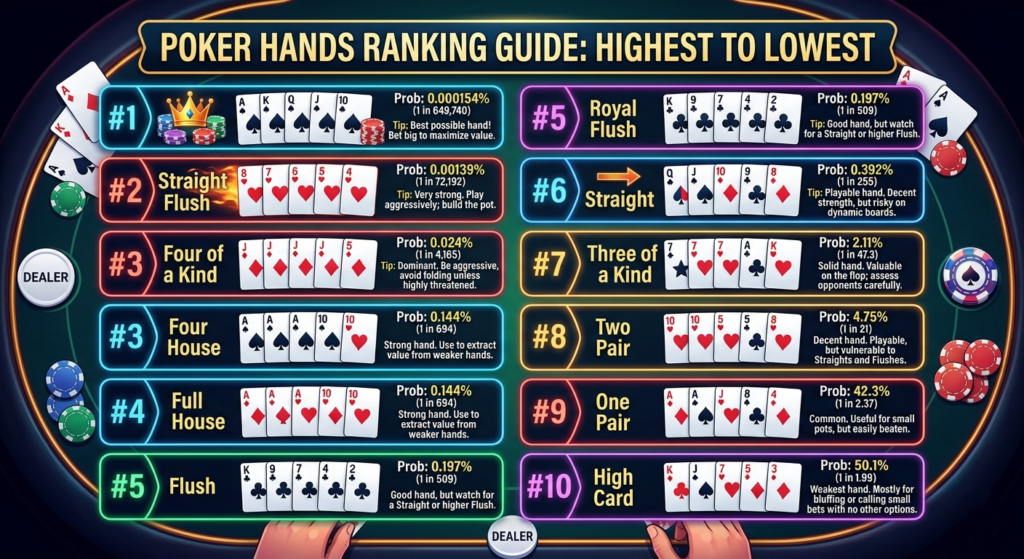
The hierarchy of poker hands is consistent across most variants, including Texas Holder. The list below ranks hands from highest to lowest, providing the foundation for all poker strategy:
- Royal Flush: A, K, Q, J, 10 of the same suit – the unbeatable best hand.
- Straight Flush: Five consecutive cards of the same suit (e.g., 8, 9, 10, J, Q).
- Four of a Kind (Quads): Four cards of the same rank.
- Full House: Three of a kind plus a pair.
- Flush: Five cards of the same suit, not in sequence.
- Straight: Five consecutive cards of differing suits.
- Three of a Kind: Three cards of the same rank.
- Two Pair: Two different pairs.
- One Pair: Two cards of the same rank.
- High Card: When no other hand is made, the highest card plays.
This order forms the baseline for understanding complex game situations and evaluating starting hands in poker strategy.
The Strategic Importance of Poker Hand Rankings
Beyond knowing the rankings, grasping their strategic implications is crucial. For example, a Full House generally beats a Flush, but understanding how frequently such hands occur affects betting decisions. Recognizing when your hand is likely the best allows for aggressive play, while weaker hands or draws might warrant conservative strategies.
Beginners can benefit from memorizing these rankings and pairing that knowledge with probability concepts found in detailed resources like Texas Hold’em probabilities, which help quantify the chances of hitting certain hands on the flop, turn, or river.
Understanding Poker Hand Probabilities
Knowing how likely each hand is to occur adds depth to playing poker effectively. For example, the extremely rare Royal Flush occurs about once in every 650,000 hands, while One Pair is the most common starting point. These probabilities advise players on the value of hands during betting rounds.
For an extensive overview, Wikipedia’s poker probability page provides a comprehensive breakdown across different game types and scenarios.
Kicker Rules and Tiebreaks: When Hands Are Equal
Ties in poker require additional rules, often centered on the kicker — the highest card outside a made hand that determines the winner if two players share a similar ranking. Understanding poker tie situations and kicker rules is essential for real-game clarity.
- Example: If two players have a pair of Queens, the winner is decided by the other cards (kickers) in their hands.
Practicing how kickers influence outcomes prevents costly mistakes especially in high-stakes or tournament settings.
Visual Aids for Learning Poker Hand Rankings for Beginners
Charts and infographics are powerful tools for beginners to quickly memorize rankings and probabilities. Visual aids depict hand strength and precedence at a glance, supporting quick recall during play and helping those new to poker grasp concepts like starting hands in poker strategy.
Stake Predictor Tools: AI and Algorithmic Assistance in Poker and Beyond
Beyond hand rankings, the rise of AI-based prediction tools in online casinos, especially at platforms like Stake.com, is reshaping gameplay decision-making.
Stake Mines Predictor Tools
Tools predicting outcomes in Stake Mines operate on pattern recognition and probability estimations, aiming to identify safe clicks by analyzing previous game results and mine distributions. While these tools offer strategic insights, their accuracy can vary and they do not guarantee success.
Stake Blackjack Predictor Tools
Similarly, blackjack predictors at Stake use statistical models and sometimes card counting algorithms adapted for digital play to suggest optimal hits, stands, or bets, enhancing player strategy without assuming perfect prediction.
Other AI-Based Prediction Tools
Advanced prediction tools combining AI and machine learning analyze gameplay data to identify patterns or tendencies, automating betting strategies or suggesting decisions based on real-time probabilities.
For a detailed exploration of Mines predictors and their strategic use, see this in-depth playbook. Complementary strategies and user concerns about fairness are also discussed at how to play Mines with strategy tips and fairness debate on Stake Mines.
Risks and Realism: Betting Tools vs. Poker Fundamentals
While AI and predictive algorithms represent a new frontier in gambling optimization, they come with limitations and risks. No tool can predict outcomes with certainty due to the inherent randomness and provably fair systems used by online casinos like Stake.com.
Players should view these tools as supplements rather than replacements for understanding poker hand rankings and strategic decision-making based on probabilities and game theory, not just algorithmic suggestions.
Final Insights: Merging Rankings, Strategy, and Technology
Mastering poker hand rankings is essential for any serious player, delivering the groundwork for winning strategy. When combined with a solid grasp of probabilities and kicker rules, players can navigate ties and betting situations confidently.
Incorporating emerging AI-driven predictor tools, while keeping realistic expectations, can complement traditional poker skills without undermining fundamental knowledge. This balanced approach enables improved gameplay through informed decisions rather than reliance on unproven assurances.